
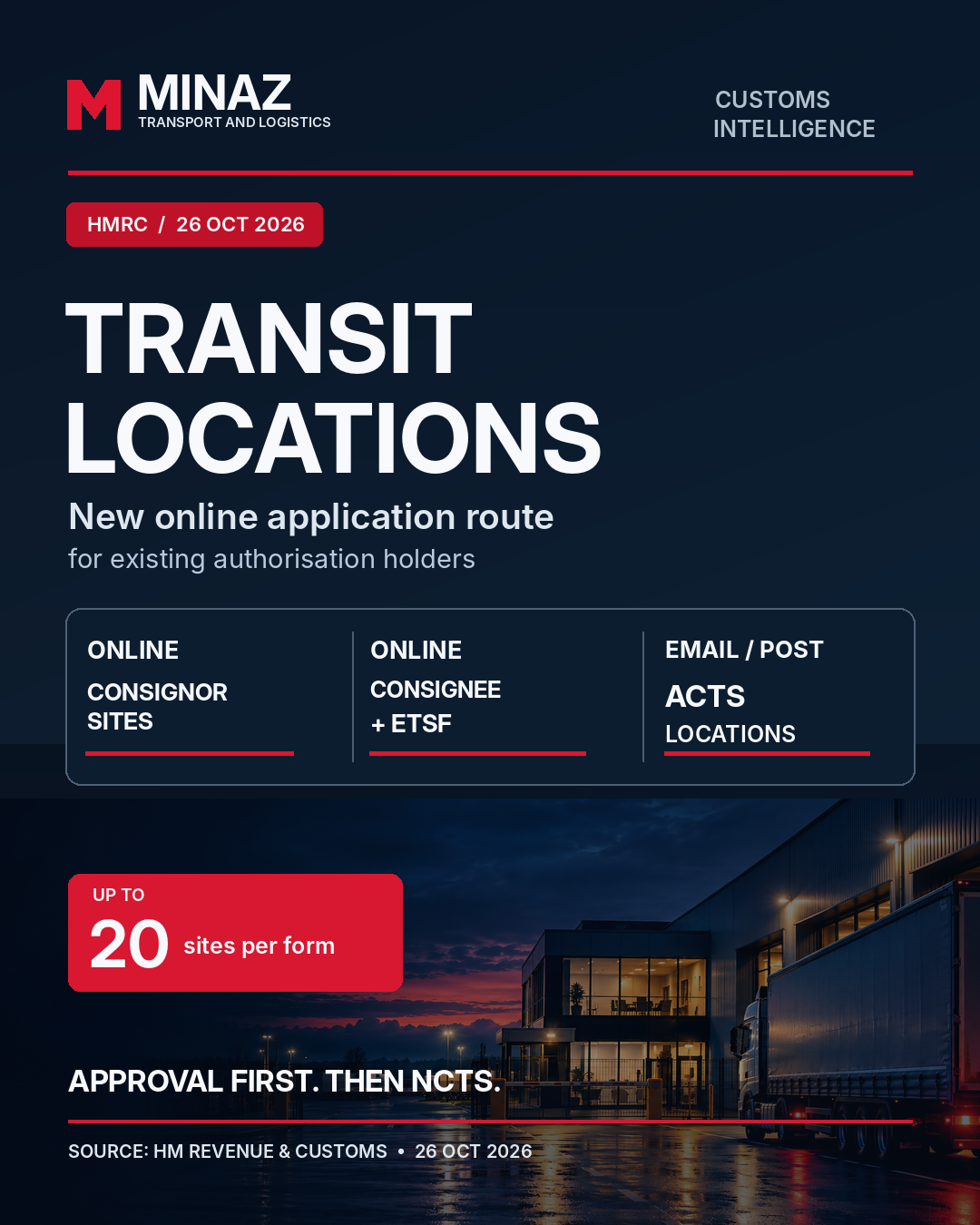
Use HMRC's new online form only for additional authorised consignor sites or authorised consignee sites that already hold ETSF approval. ACTS locations still use the email/post process. No new site should enter the NCTS operating plan until HMRC confirms its reference number and permitted start date.
What changed on 26 October
HMRC's October 2026 transit newsletter confirms that a new online form is available to add locations to an existing authorised consignor or consignee authorisation. Previously, the published application process relied on forms submitted by email or post. The online route is intended to make eligible additions simpler, but it does not replace the underlying conditions attached to a trader's authorisation.
This is relevant when an established transit operator adds an additional dispatch warehouse, a customer-controlled loading point or an approved arrival facility. It does not mean that any importer, haulier or forwarder without the appropriate existing authorisation can add a location through the new form.
Who can use the online form — and who cannot
HMRC allows online submissions for new authorised consignor locations and for authorised consignee locations that will operate as an external temporary storage facility (ETSF). An authorised consignee location must already have ETSF approval before being added through this route, and its ETSF reference number is needed in the application.
A proposed authorised consignee temporary storage (ACTS) location must instead be applied for by email or post, because HMRC requires additional evidence and may need to inspect the site. The official guidance identifies forms C1343d and C1343b for ACTS applications. Operators unable to use the online route for eligible sites can still submit form C1343d by email or post.
An operator needs the right existing authorisation for the role: an authorised consignee authorisation does not itself permit an operator to add a consignor site. Each approved site operates under the terms and conditions of the underlying authorisation.
Check the premises and controls before applying
For authorised consignor locations, HMRC asks operators to review whether their guarantee reference amount can cover additional transit movements. Each proposed site should be a legitimate commercial premises with secure goods handling, adequate records, customs access and control measures consistent with the authorisation.
The location must be able to supply the driver with the movement reference number (MRN), and when requested, a paper Transit Accompanying Document (TAD). If the operator does not own a location, HMRC may ask for a commercial agreement with the owner that incorporates the relevant authorisation conditions.
For consignee locations, confirm whether the site already has ETSF approval or is instead to operate as ACTS. HMRC states that ETSF and ACTS cannot operate at the same location simultaneously, and ACTS approval for an existing site does not automatically extend to a new one.
Application workflow: EORI access and up to 20 sites per form
The HMRC guidance says the online application requires a sign-in account linked to the EORI used for the existing transit authorisation. Operators should match the authorisation holder, location type, premises details and relevant temporary-storage approval before submitting.
There is no stated overall limit to the number of locations covered by a single authorised consignor or consignee authorisation, but each form may include up to 20 locations. Organisations adding several sites should prepare one consistent record for each address, nominated control arrangements and approval references, rather than treating a multi-site application as a blanket authorisation.
Approval and NCTS readiness are separate from submission
Submitting the form does not activate a site immediately. HMRC says new authorised consignor locations are usually activated within three working days of receiving the submission. Authorised consignee locations already approved as ETSFs are usually activated within five working days. These are typical processing times, not guaranteed service levels; incomplete information can cause delays.
For ACTS sites, review of supporting documents and a possible physical inspection can take several weeks. HMRC will send confirmation of the new location reference numbers and the date they can be used on the New Computerised Transit System (NCTS), together with updated authorisation paperwork.
HMRC also asks the operator to acknowledge receipt of its approval email. Until the stated NCTS start date is confirmed, planners should retain the current authorised location in live transit instructions rather than assume the newly submitted address is operational.
What this means for UK–EU freight planning
The UK and European Common Transit system can allow goods to move under transit procedures, but the operational start or end point depends on the responsible trader's customs simplifications and approved premises. A shipper may prefer a collection or arrival at a convenient warehouse, yet the authorised transit location and its NCTS availability must still be checked with the responsible operator.
For forwarders coordinating road freight, the useful control is an authorisation-specific location register: the site address, consignor or consignee role, temporary storage type, authorisation holder, reference number, activation date and contact for driver MRNs/TADs. That is more reliable than relying on a generic note that a company is an authorised operator.
Where a location is being added close to a planned dispatch, agree the fallback with the authorisation holder before allocating a vehicle. HMRC's published processing windows are not a substitute for written confirmation that the site can actually be used.
A practical pre-dispatch checklist
Before committing a load to a new UK transit location, ask: Does the operator hold the correct authorised consignor or consignee authorisation? Does the specific proposed consignee site already have ETSF approval, or will it need the ACTS route? Are EORI-linked application access, guarantee cover, contracts and site controls in order? Has HMRC issued the site reference and effective NCTS date?
Share the confirmed address and reference with the customs declarant and the transport team. Keep the MRN/TAD process, site reception instructions and escalation contacts consistent across the booking, declaration and driver brief. The online form removes a piece of paperwork for eligible operators; it does not remove the responsibility to verify each shipment's transit procedure.