
Treat the diesel increase and the energy-concern survey as reasons to verify fuel-surcharge formulas, quote-validity windows and confirmed lane capacity—not as automatic evidence of a specific UK–EU freight-rate increase.
The headline: energy becomes a leading transport-sector concern
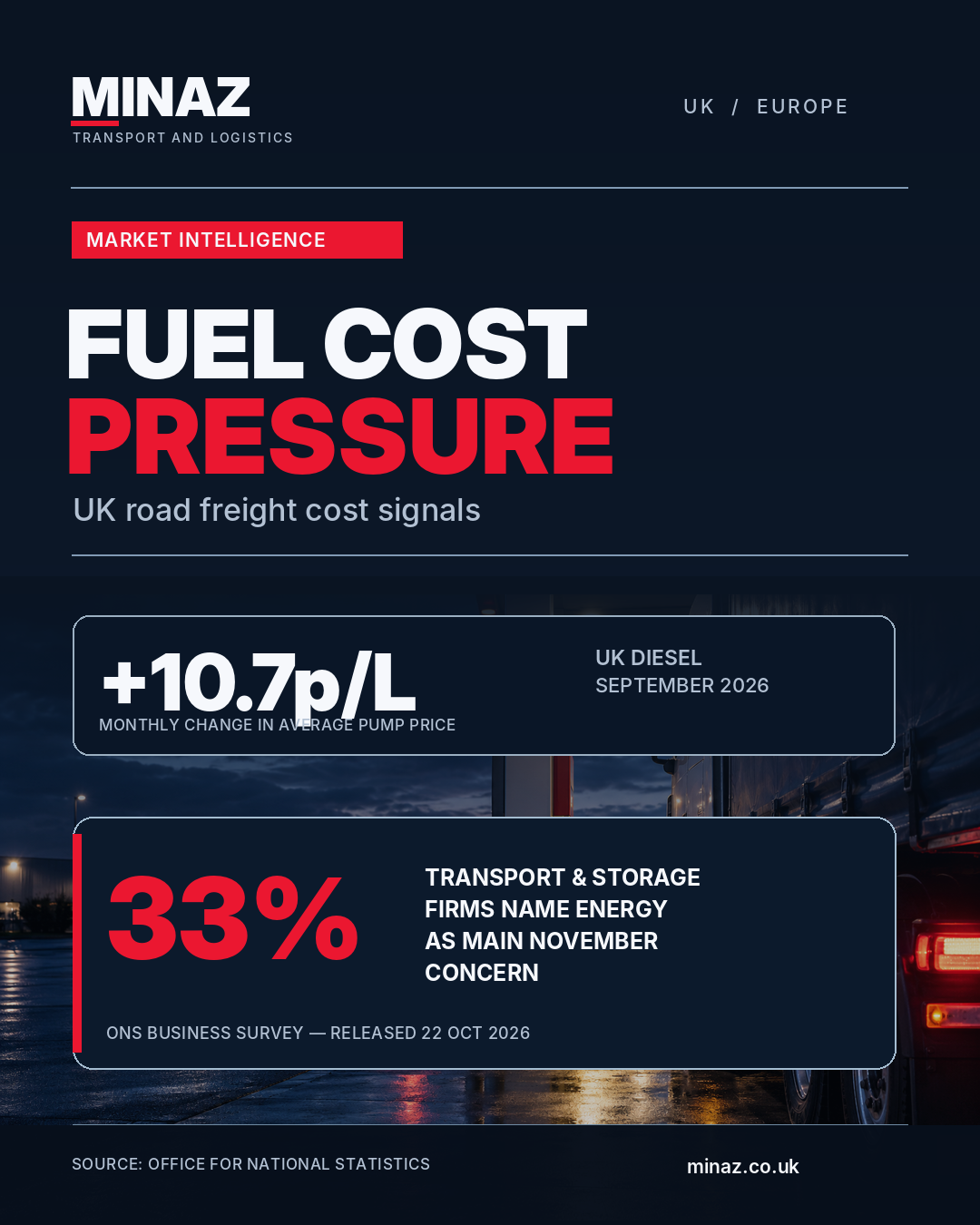
The ONS Business Insights and Conditions Survey (BICS), published on 22 October 2026, reports that 33% of businesses in the transportation and storage industry chose energy prices as their main concern for November. That was the largest share recorded among the industries highlighted in the bulletin. This question is about the main anticipated business concern, not the proportion that reported a measured fuel-cost increase, nor the percentage change in haulage rates.
Across businesses in general, 72% reported some degree of concern about increases in fuel prices in early October, including 38% who were very concerned. This 72% figure is an all-industry measure and must not be presented as a haulage-only statistic. The wave 166 voluntary survey collected responses from 5 to 18 October, so its estimates describe businesses' views during that period.
What the September diesel data actually measures
In its Consumer Price Inflation release on 21 October, the ONS estimated the average UK diesel pump price at 192.5 pence per litre in September 2026, up 10.7 pence since August. Petrol averaged 169.5 pence, up 8.2 pence. Overall motor fuel prices were 29.8% higher than in September 2025, compared with 23.0% annual growth in August.
These are consumer fuel-price statistics, not a national price paid by all freight operators. Bulk fuel contracts, bunkered supplies, fuel cards, tax treatment and the specific timing of purchases can produce materially different cost exposure for transport suppliers. A rise in a retail pump-price series is an important warning sign but is not a defensible replacement for a carrier's documented fuel basis.
Why the broader inflation picture matters—but is not a freight tariff
UK CPI inflation rose to 3.5% in the 12 months to September 2026, from 3.1% in August. The ONS identifies transport, especially motor fuels, as the largest upward contribution to the change in the annual rate of inflation. The transport division of CPIH rose 6.6% over 12 months, compared with 4.6% in August. These aggregates cover many consumer transport expenses beyond road freight.
For a shipper this matters mainly as context: fuel exposure and household purchasing power can move in different directions at once. The separate ONS retail release of 23 October estimates a 0.4% monthly decline in Great Britain's retail sales volume in September even though volumes rose 0.7% across the third quarter. Retail volumes are not truck journeys or pallet counts, and monthly readings can be volatile. The data do not justify a claim that any particular UK–EU lane is weakening.
What to verify before accepting a revised freight quote
Ask whether a fuel adjustment applies at all, whether it is included in the base price or added separately, what published benchmark it references and which observation date is used. Establish the trigger threshold, adjustment frequency, cap or floor if one exists, and whether the same rule applies in both directions. An understandable written formula is more useful than an unsourced percentage described as 'market fuel'.
Next, separate road movement, terminal handling, shipping or crossing costs, waiting time, customs administration and currency exposure. A fuel-driven cost change should not silently become a blanket uplift to unrelated services. For mixed-mode UK–EU movements, the applicable rate basis can differ between UK collection, international leg and continental delivery. Obtain a current itemised quotation for the actual shipment rather than importing a general market figure into the budget.
Use shipment evidence—not sentiment—to manage capacity
The BICS figures indicate uncertainty for businesses, not that capacity has disappeared or that delays are inevitable. Check cargo-ready dates, booking lead times, collection windows and delivery cut-offs for the specific origin–destination pair. Ask the responsible transport provider how long a price is valid and whether a change in sailing, vehicle type or fuel index would require re-quotation.
For time-sensitive cargo, record who will approve a revised quote, how substitutions are authorised and whether a second available departure is a workable contingency. These controls are useful regardless of whether the next fuel reading rises or falls. They reduce the chance that cost discussions disrupt confirmed dispatch information.
What UK shippers should watch next
The next scheduled ONS Business Insights and Conditions Survey release is 5 November 2026; the next CPI bulletin is due 18 November and the next retail sales bulletin 20 November. They may help determine whether the October cost-concern signal persists and whether wider demand conditions change. None substitutes for a live carrier price, contract or shipment-level capacity check.
The immediate action is narrower and more practical: review fuel clauses on high-frequency lanes, confirm which cost components are indexed, and check quote validity on upcoming UK and UK–EU bookings. If a provider cites a market indicator, ensure the cited indicator, date and relevance to that leg are explicit.