
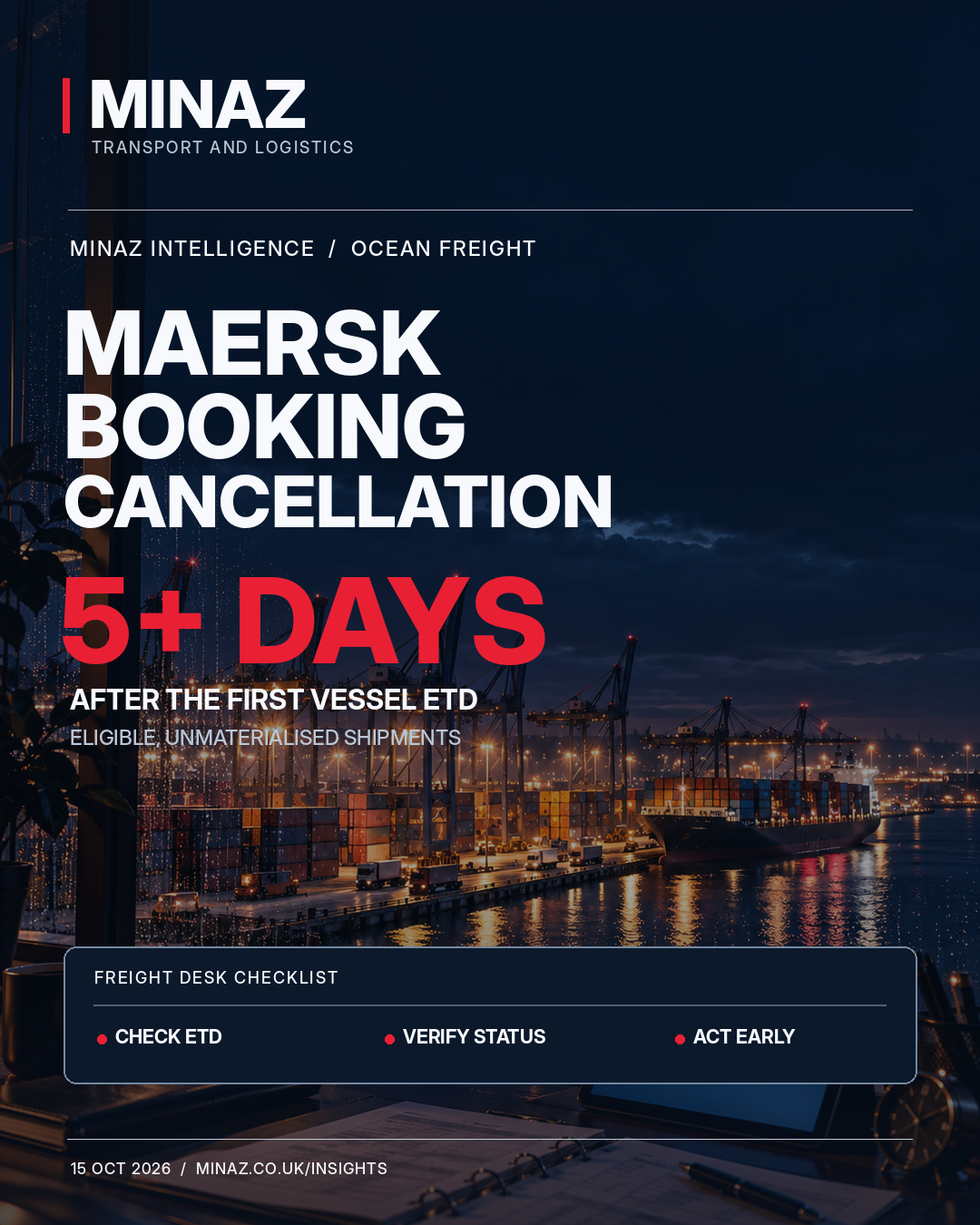
For eligible Maersk bookings, an unmaterialised shipment may face automatic cancellation once five or more days have passed since the first vessel's ETD. Audit exceptions early, confirm the applicable booking status directly with Maersk, and do not assume this is a rule for every carrier or every booking.
What Maersk actually changed
Maersk’s customer advisory dated 15 October 2026 states that eligible shipments which have not materialised may be automatically cancelled when five days or more have elapsed since the first vessel’s estimated time of departure. The carrier says the purpose is to release unused capacity sooner and improve transport planning. The wording is conditional: it does not say every booking will be cancelled on the fifth day.
Two details are essential. The reference point is the first vessel’s ETD, not the day a quotation was requested or a booking was created. And the advisory does not define every eligibility condition or what counts as a shipment having 'materialised'. Teams must check the affected booking with Maersk rather than fill those gaps with assumptions.
Why this matters for UK-connected freight
A delayed UK export collection, missing customs or commercial paperwork, container or cargo-readiness problems, and an unconfirmed shipment handover can all leave a booking record out of step with the physical movement. These are examples of situations worth reviewing—not a carrier-published list of automatic-cancellation triggers. A UK importer managing a supplier’s overseas loading plan may face the same visibility problem at origin.
The timing also comes during a period when Maersk’s October Europe market update discusses Asia–Europe schedule adjustments after seasonal weather in Asia Pacific and advises closer monitoring of cargo milestones across Northern Europe. This context increases the practical value of clear exception handling; it does not establish that the new five-day threshold was introduced because of any specific port or route disruption.
Do not confuse a booking milestone with an ocean departure
An ETD is a scheduled vessel milestone, while cargo-ready dates, terminal cut-offs, customs release and actual loading are different events. A revised sailing schedule can make an export file harder to interpret if each team is looking at a different timestamp. Keep the carrier's first-vessel ETD, subsequent schedule revisions and current booking status together in the transport record.
Do not assume that moving to a later vessel, sending a document, or changing an internal TMS status resets the carrier’s eligibility assessment. If cargo is still intended to move but appears dormant, ask Maersk to confirm whether cancellation could apply and which action is required for that booking.
A five-point check for the freight desk
First, identify Maersk bookings with a first-vessel ETD already passed and no verified shipping progress. Second, compare booking references against cargo readiness, container release, gate-in or handover evidence as applicable. Third, locate the outstanding blocker and name the responsible party—shipper, supplier, forwarder, customs representative or terminal interface.
Fourth, contact Maersk promptly for an authoritative status and the next valid shipping option when the movement is still required. Fifth, record the carrier response, the current booking ID, any replacement booking, the agreed next milestone and the customer communication. A short daily exceptions review is more reliable than waiting until a booking disappears from a status dashboard.
What a forwarder should tell the customer
Keep the message operational and specific: the carrier has introduced a conditional automatic-cancellation timeline for eligible, unmaterialised shipments; the threshold is five days or more after the first vessel ETD; and confirmation is needed for the particular booking. Explain what is known, what is waiting on Maersk, and whether collection or delivery instructions should pause.
Avoid claiming an automatic penalty, guaranteed loss of space, or mandatory cancellation for every booking—none of those universal claims appears in the carrier advisory. Any commercial cost or rebooking terms should be checked against the relevant contract and carrier confirmation.
The wider lesson: track exceptions, not only bookings
The UK Government Office for Science’s September 2026 supply-chain foresight report emphasises that risk can be concentrated at shared nodes, supplier tiers and bottlenecks beyond headline trade flows. At shipment level, the matching discipline is to connect physical events, documents, carrier milestones and responsible people before an exception becomes a missed departure.
For UK–EU and wider overseas cargo alike, a booking checklist should answer four questions: has the shipment progressed physically, what milestone is authoritative, who is resolving the hold, and when will the carrier confirm its status? That is a practical response to Maersk’s update without extrapolating a carrier-specific policy to the wider freight market.