
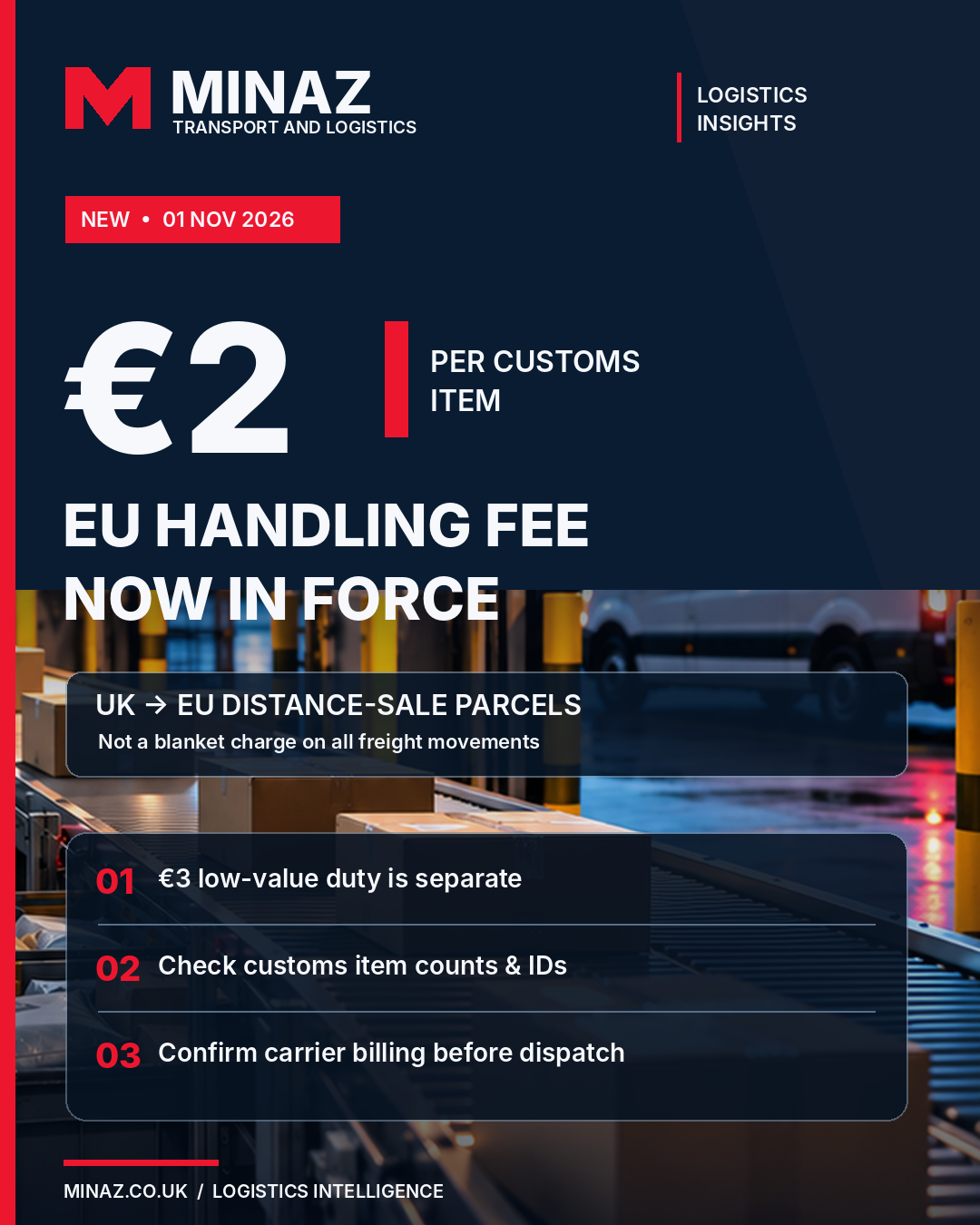
The €2 Union handling fee started on 1 November 2026 for qualifying EU distance-sale imports; it is separate from the €3 low-value duty introduced on 1 July. UK e-commerce shippers should confirm product/declaration-line counts, identifier requirements, the responsible declarant, charging arrangements and country-specific operational guidance before dispatch. Do not apply the fee indiscriminately to ordinary bulk freight or assume Northern Ireland treatment is identical.
The change that took effect on 1 November
The Council of the European Union confirms that its Union handling fee became applicable across EU member states on 1 November 2026 at €2 per item for the relevant small consignments sold through distance selling. The fee is intended to support customs processing and control work in a system handling large volumes of e-commerce imports.
This is an EU customs measure for imported distance-sale goods; it is not a flat €2 toll on every road consignment crossing from Great Britain, or a substitute for VAT and other customs obligations. The scope and calculation need to be checked against the actual declaration and product mix.
Do not confuse the €2 fee with the €3 customs duty
Two measures are now running side by side. The EU introduced a temporary €3 customs duty from 1 July 2026 on qualifying low-value distance-sale imports worth up to €150. The separate €2 Union handling fee applies from 1 November. The €3 levy is a customs duty; the €2 levy is an administrative handling charge. The Council says the temporary €3 arrangement is to run until the EU Customs Data Hub becomes operational for e-commerce.
UK government trade guidance explains that consignments under €150 can incur both measures where applicable, while higher-value relevant distance-sale imports remain subject to normal applicable tariff duties as well as the handling-fee rules. This does not mean simply adding €5 to every parcel without checking the contents, valuation, classification and declaration procedure.
What 'per item' means for commercial invoices and customs data
The charge is not safely modelled as one fee per physical parcel. Both EU and UK guidance direct traders to the customs meaning of an item, with the UK exporter guidance pointing to section 5.2 of the Commission's technical explanation. Different product categories and declaration lines can produce different totals.
Before a parcel is packed, agree how SKUs map to tariff codes and customs declaration items. Check descriptions, commodity classification, quantities, values and the use of H1, H6 or H7 declarations with the express operator or customs intermediary. A simple parcel-count model may understate costs or misallocate them to customers.
Product identifiers are another 1 November task
The European Commission's guidance on the low-value import changes says product identifiers became mandatory from 1 November 2026 for the relevant e-commerce declarations, after a voluntary period from 1 July. The purpose is to improve identification and traceability of products, not to replace the need for accurate goods descriptions and commodity coding.
Data teams should therefore check the product identifier fields expected by their filing route and the customs software or carrier. Ask specifically whether any changes are needed to fulfilment exports, marketplace feeds or broker mapping. The requirement should not be extrapolated to every standard commercial import without checking the underlying customs procedure.
Identify the party that files and the party that pays
UK businesses using online marketplaces, postal channels, express integrators or third-party fulfilment may have different customs data flows. Responsibility for a declaration, collecting a duty or fee, and recovering it from the seller or buyer are not interchangeable concepts.
The EU customs reform also changes the legal treatment of e-commerce platform operators over its phased implementation. For shipments booked now, establish which operator is the importer or deemed importer, who is the declarant or representative, what services are covered by the carrier invoice and whether a further charge appears on delivery. Do not promise the customer duty-paid delivery unless the agreed commercial terms and service actually support it.
A specific caution for Northern Ireland movements
The UK Department for Business, Innovation, Science and Trade notes in its 30 October guidance that further advice on movements into Northern Ireland will follow. Businesses should not take the EU-mainland examples and assume they translate automatically to every Great Britain–Northern Ireland or onward movement.
Use the applicable Windsor Framework, customs and parcel arrangements and the instructions of the relevant declarant. If the flow is complex, seek route-specific professional customs advice rather than a generic surcharge table.
A practical dispatch checklist for UK exporters and forwarders
First, segment shipments by destination, sales model, value and declaration type; distinguish distance-sale parcels from ordinary business-to-business freight. Second, audit the product catalogue for accurate tariff codes, descriptions, quantities and required identifiers. Third, request from the postal or express carrier a written fee schedule and clear examples for mixed-category parcels. Fourth, confirm the importer/declarant arrangement and which party is liable for EU charges under the chosen delivery terms.
Finally, revise customer-facing checkout totals and exception processes only after the actual filing and billing rules are confirmed. Keep a record of customs instructions, the agreed responsible party and the effective date for every relevant shipping service. The goal is fewer unexpected bills, rejected data sets and delivery disputes — not an unsupported prediction that all EU-bound freight rates must rise by the same amount.