
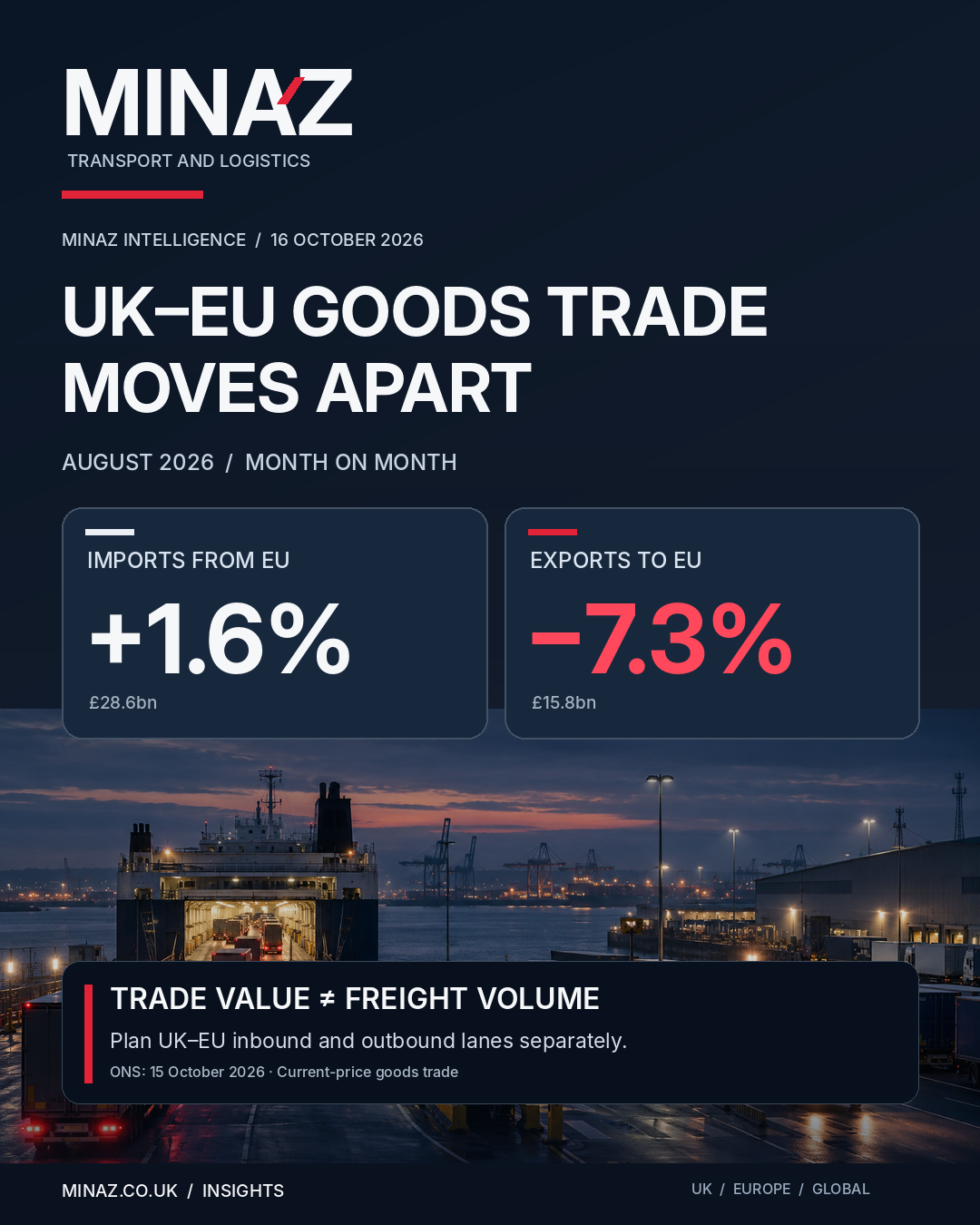
August's UK–EU trade-value split is a prompt to review inbound and outbound bookings independently. Validate each lane against confirmed orders, cargo dimensions, delivery windows and customs ownership; do not treat a change in trade value as a matching change in freight volume or capacity.
August's inbound and outbound numbers moved apart
The ONS estimates August 2026 UK goods imports from the EU at £28.6 billion, up £0.5 billion (+1.6%) from July. UK goods exports to the EU were £15.8 billion, down £1.2 billion (−7.3%). Both series are in current prices and seasonally adjusted, with precious metals excluded.
Across all trading partners, UK goods imports fell £1.3 billion (−2.3%) and exports fell £1.1 billion (−3.1%). The EU movement was therefore different from the overall imports picture, because lower imports from non-EU countries outweighed the rise from the EU. The August update is material new evidence following July's earlier export rebound, not proof of a permanent direction change.
The commodity mix matters more than the percentage
ONS attributes the EU import increase partly to machinery and transport equipment (+£0.3 billion) and to chemicals and fuels (about +£0.2 billion each), offset by smaller declines in other categories. Aircraft from Germany, pharmaceutical products from Germany and refined oil from the Netherlands contributed to the movements. These examples matter because aircraft, pharmaceuticals and oil do not travel through the same road-freight networks.
On the export side, EU-bound goods values fell across machinery and transport equipment (−£0.5 billion), material manufactures and fuels (about −£0.3 billion each), and chemicals (−£0.2 billion). ONS cites fewer aircraft exports to the Netherlands and lower values for certain metals and fuel products. Neither an aircraft movement nor an oil shipment should be translated automatically into truck availability at Dover or a rate on a particular road lane.
Trade value is not freight capacity
The ONS bulletin separates current-price values from chained volume measures, which remove the effect of price changes. In inflation-adjusted terms, EU goods imports rose 1.6% and EU exports fell 7.1% in August. But even a volume measure of goods trade is not equivalent to physical cargo tonnes, containers or trailer departures.
High-value, low-weight products can shift monthly trade value without creating proportionate vehicle movements. One-off deliveries, changes in product mix and statistical revisions can also affect the series. Use the ONS data as context and check actual transport bookings before assuming a lane is busier or quieter.
Three practical checks for UK–EU shippers
First, separate confirmed inbound and outbound purchase orders by route, commodity, Incoterms and required delivery date. Compare the last four weeks of actual booked collections, not just quote enquiries, and identify cancelled or delayed orders.
Second, review lane-level capacity and quote validity with carriers and forwarders. Check customs/declaration responsibilities, warehouse receiving windows and return-load assumptions independently for each direction. An aggregate change in trade value cannot settle whether a specific crossing or collection day has spare capacity.
Third, test the shipment specification before acting on a headline: origin and destination, package count, dimensions, gross weight, stackability, time restrictions and commodity classification. Those details drive the real freight plan regardless of national trade-value shifts.
What to watch next
The next ONS UK trade bulletin is scheduled for 12 November 2026. Watch whether the EU import/export divergence persists in subsequent releases and whether the shifts are concentrated in a few high-value commodities rather than broad cargo categories.
In the meantime, a freight booking desk should use confirmed customer orders and carrier availability as its operational source of truth. MINAZ's reading of the figures is a planning prompt, not a prediction of freight rates or journey counts.