
Separate the supplier’s product price, any energy-related adjustment and the actual freight quote. Use the relevant product and market evidence, rather than applying the EU headline index to every shipment.
The new figures: a sharp difference beneath the headline
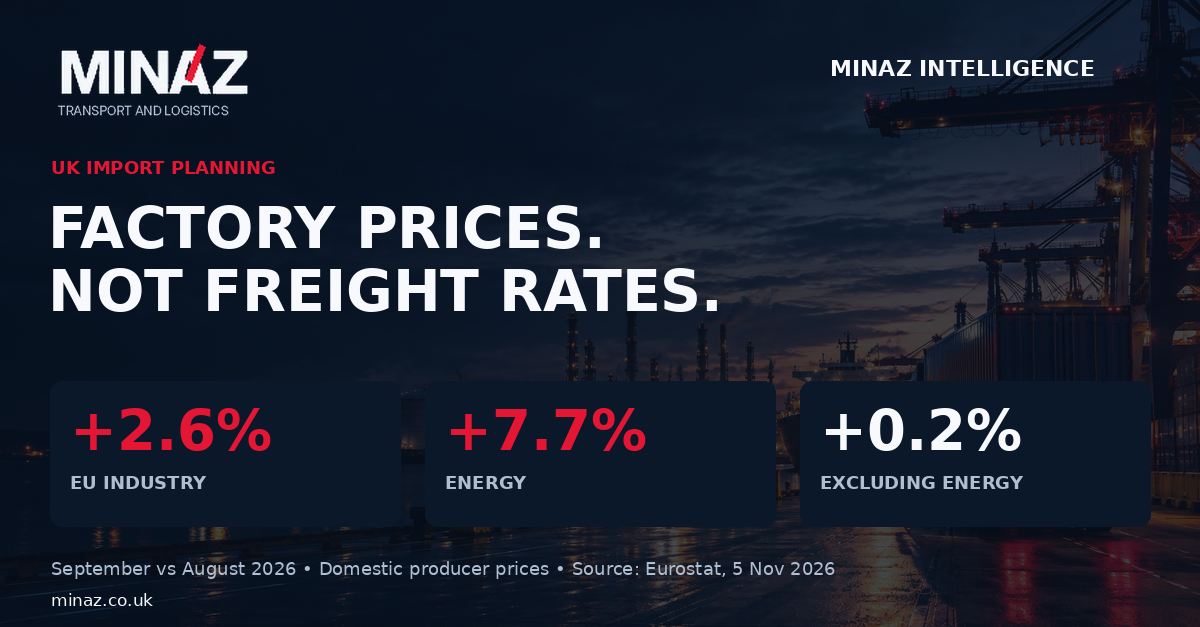
Eurostat’s first estimates show that industrial producer prices on the EU domestic market increased by 2.6% in September 2026 compared with August. Energy prices rose by 7.7%, while total industry excluding energy increased by 0.2%. The EU headline was 10.9% higher than in September 2025. The monthly and annual comparisons describe different periods and should not be mixed. [1]
These figures support a narrower conclusion than ‘everything became 2.6% more expensive’. The release contains markedly different movements across industrial groupings. A buyer should therefore start with the category of goods being sourced, rather than treating the aggregate as an explanation for every supplier’s revised quotation. That is MINAZ’s planning interpretation, not a forecast issued by Eurostat.
What the index measures — and what it does not
A producer-price index measures changes in selling prices from the producer’s perspective. Eurostat distinguishes domestic and non-domestic markets; the release used here concerns domestic-market producer prices. It is therefore not an index of UK import invoices, road-haulage rates or container-shipping charges. [1][2]
This distinction matters for a cross-border purchase. The relevant export price, commercial terms and transport service need their own evidence. An index can provide context for a negotiation, but it cannot identify the agreed price of a particular product from a particular supplier on a particular delivery date. Nor does a price movement, on its own, tell us how many pallets, trailers or containers will need to move. This is a limitation of the measure, not evidence that any individual cost increase is unjustified.
The UK context is informative, but not directly interchangeable
The ONS release of 21 October reports that UK manufacturers’ input prices increased by 1.5% on the month in September 2026, while factory-gate output prices rose by 0.8%. The corresponding annual increases were 8.3% and 4.6%. ONS identifies crude oil and refined petroleum among the important contributors to the respective changes. [3]
These UK series and the EU domestic-industry series do not have identical coverage. They should not be combined into a single percentage uplift or used as interchangeable freight indices. For a UK import team, their value is contextual: they justify asking more precise questions about which part of a quotation changed, and which supporting measure is actually relevant to it.
Three checks before accepting a revised landed-cost estimate
First, ask the supplier to distinguish a change in the underlying product price from a separately identified energy adjustment. Confirm the product specification, quantity, currency, validity period and delivery terms used for the comparison. If an index is being cited, ask which series, market and reference month it covers. This is a suggested review process, not a new regulatory obligation.
Second, review the freight quotation independently. Identify what is included in the base charge and what is a variable surcharge. Request the actual applicable basis and dates instead of assuming that the producer-price headline also measures transport costs. Third, align the purchasing decision with the operational plan: confirm the cargo-ready date, collection window and delivery requirement before committing to a changed shipment pattern.
Do not turn a price signal into an untested stock decision
A possible reaction to a cost headline is to bring an order forward or increase the batch size. That may be appropriate for a particular business, but the headline alone cannot settle the decision. Our recommendation is to compare the supplier’s actual revised terms with the commercial consequences of holding more stock and the transport arrangements needed to deliver it.
For example, a buyer could compare keeping the original delivery pattern with consolidating the next order. Both options should use current quotations and the same service assumptions. The outcome may favour either approach. The useful discipline is to make the assumptions visible, rather than presenting an economy-wide percentage as proof that a larger order will save money.
A practical brief for the next supplier and forwarder conversation
Bring the old and new product quotations, the named index if one is referenced, the proposed cargo-ready date and an itemised transport quote to the same review. Ask what has changed, who bears each variable charge and how long each price remains valid. Keep the discussion tied to the shipment and the contract, not just the headline.
MINAZ’s editorial conclusion is to use the new release as a prompt for a structured cost review. It does not establish spare transport capacity, a universal surcharge or a guaranteed saving from a different route. This article is market analysis; it makes no announcement about MINAZ pricing, fleet, facilities or commercial commitments.
Source dates and scope
The headline event is Eurostat’s release dated 5 November 2026, covering September compared with August and with September 2025. Eurostat’s methodological overview explains the distinction between domestic and non-domestic producer prices. The UK comparison uses the ONS bulletin released on 21 October 2026. The ONS bulletin labels the latest producer-price estimates as provisional. Operational suggestions above are MINAZ’s interpretation and should be checked against the parties’ actual quotations. [1][2][3]