
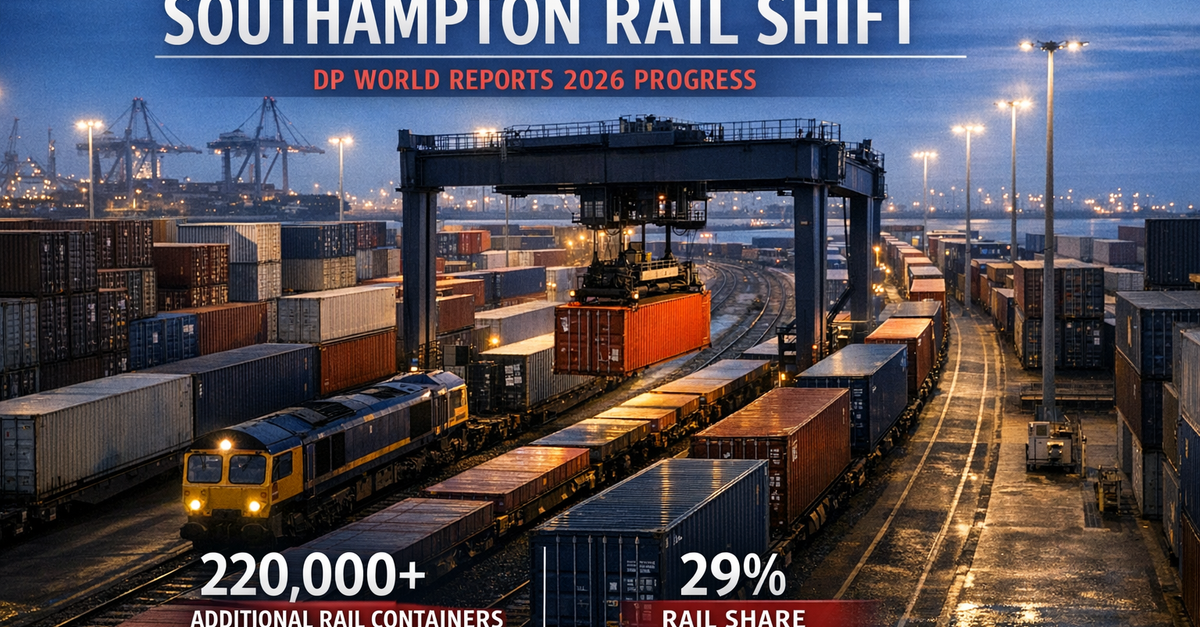
DP World reports more than 220,000 additional containers transported by rail since 2023, with rail's share of container movements rising from 21% to 29%. For a specific import, compare the railhead, service availability, onward road delivery and the scheme's exact incentive conditions before changing the transport plan.
What DP World reported on 17 November 2026
DP World announced that its Southampton Modal Shift Programme had supported the movement of more than 220,000 additional containers by rail since September 2023. The company estimates that this activity avoided around 18 million miles of road transport and 50,000 tonnes of carbon dioxide equivalent (CO₂e) emissions. Those figures describe the operator's cumulative programme assessment; they are not the total number of containers handled at Southampton or independently audited national emissions savings.
The same announcement says rail's share of onward container movements from Southampton increased from a 21% starting point to 29%. That is an increase of 8 percentage points in the operator's reported share, not an 8% increase in the absolute number of containers. A port-level rail share does not describe all freight routes serving Great Britain.
Why the programme was introduced
The Modal Shift Programme began on 1 September 2023. Its purpose is to make the use of rail more financially attractive for import-laden containers leaving DP World Southampton. The programme focuses on movements to qualifying inland railheads in an incentive zone extending approximately 140 miles from Southampton. It was initially introduced as a trial and has since continued with revised payment arrangements.
Instead of assuming rail is cheaper on every journey, the arrangement addresses part of the commercial difference between road and intermodal services. The operator applies a £10 programme fee to import-laden containers arriving at the terminal and provides incentives for eligible containers moved by rail. The charge and incentive are different components of the scheme; a freight quotation should show who pays and who receives each amount.
The current incentives are conditional, not an automatic rebate
DP World's published terms for 1 October to 31 December 2026 set a £35 incentive per qualifying import-laden container moved by rail within the programme zone. The scheme describes this payment as payable to the import clearing agent. The £10 fee per import-laden container remains in place. The incentive does not apply to a container moved solely by road, and the terms should not be interpreted as a £35 discount automatically received by every cargo owner.
For the same 1 October to 31 December 2026 period, DP World describes a separate £35 performance-based disbursement per eligible rail container for rail freight terminal operators. It is conditional on individual operators meeting quarterly rail-volume targets, and DP World says that payment must be passed to freight operating companies. These arrangements concern programme participants, not a change to import duty, VAT or customs declaration rules. Commercial teams should confirm the current advisory, the eligible railhead and the payment flow for their own bookings.
Routes and the significance of a 29% rail share
DP World says the programme supported the introduction of 5 rail services linking Southampton with Birmingham, Cardiff, East Midlands Gateway, Doncaster and Northampton. These connections illustrate how a maritime terminal can use inland rail to serve regional logistics centres. The announcement does not establish that a train is available on a particular day or that space is guaranteed for an individual consignment.
An increase in rail's share from 21% to 29% can improve modal choice for suitable containers, but it does not remove the need for road haulage. Containers may still need road collection from the inland railhead and road delivery to the final consignee. For operators planning time-sensitive loads, terminal cut-off times, train availability, customs status and delivery appointments still determine the workable route.
How to interpret the claimed environmental benefit
The estimated 50,000 tonnes of CO₂e avoided and 18 million road miles avoided are figures reported by DP World for the cumulative Southampton programme. The company has not presented them in this announcement as measured emissions for every shipment or as a standard saving per container. A company calculating its own logistics emissions should use its actual transport legs, distances, vehicle and rail information and an appropriate reporting methodology.
These estimates are useful as an indication of the scale claimed by the operator, but they should not be multiplied into a shipment-level carbon statement without supporting data. They also do not imply that the rail portion of an intermodal journey has no emissions. A robust comparison covers the rail leg, road collection, inland handling and road delivery.
What national rail statistics do and do not show
The Office of Rail and Road reported that rail freight moved in Great Britain amounted to 4,135 million net tonne kilometres in April to June 2026, an increase of 1% from the same period in 2025. The regulator published that release on 22 September 2026. A net tonne kilometre measures freight mass transported multiplied by distance, making it different from a count of containers or a share of containers leaving a single port.
The regulator's statistics are for the wider rail network and a different reporting period from DP World's cumulative programme figures. Neither dataset independently verifies the other's numerical claim. Together, they provide context: the Southampton operator is reporting a local commercial initiative, while the regulator measures freight activity across Great Britain.
Practical checks for importers and freight forwarders
Before choosing a rail-inclusive service, confirm whether the container is import-laden, whether the selected inland railhead falls within the current incentive zone and whether the service can meet the required collection and delivery dates. Ask which party receives the scheme incentive and whether any fee is already included in the port or forwarding charges. Confirm the responsible parties for rail booking, terminal handling and final road movement.
Compare the complete door-to-door cost rather than the rail tariff alone. Include inland road collection, storage risk, terminal cut-offs, equipment availability and potential disruption. For time-sensitive or unusual cargo, verify that a road-only service or another intermodal option remains operationally appropriate. The operator's programme does not replace standard customs and safety obligations.
The decision for the next booking
The 17 November 2026 announcement suggests that financial incentives and added rail services can influence how import containers leave a UK port. It does not establish a mandatory shift from road to rail. Shippers and forwarders can use the development as a reason to request comparable rail and road options where those services genuinely exist.
Check the current DP World incentive notice before agreeing a shipment price, because the published £35 conditions apply specifically to the period ending 31 December 2026 and later rates may change. Preserve the date and terms used in the quotation. The more useful operational question is whether a particular route offers a dependable combination of capacity, cost, timing and verifiable environmental information.
Southampton Modal Shift Programme begins
DP World introduces the rail incentive programme for import-laden containers at Southampton.
Current incentive period starts
DP World's £35 rail incentive and separate conditional £35 terminal-operator arrangement apply for the period ending 31 December 2026.
DP World reports cumulative programme results
The operator reports more than 220,000 additional rail containers since 2023 and an estimated 50,000 tonnes of CO₂e avoided.