
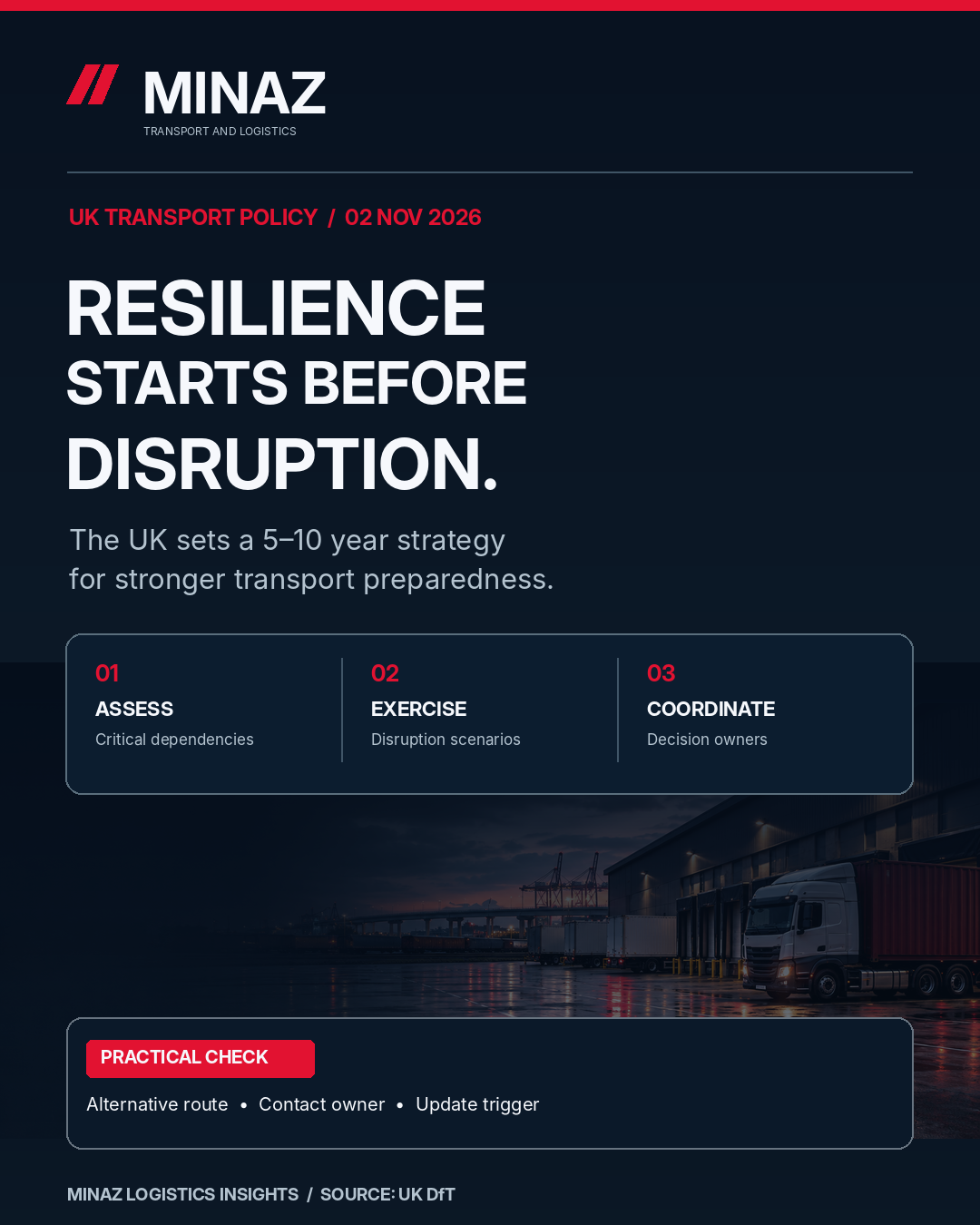
The new UK strategy is a long-term policy framework, not a freight operating mandate or evidence of an immediate capacity change. Use it as a prompt to test route alternatives, escalation contacts, cargo priorities and recovery decisions before disruption—not during it.
What the government announced on 2 November
The Department for Transport says its transport resilience strategy will guide work over the next five to ten years. Its objectives include assessing the system's resilience continuously, helping users and operators take action, and strengthening government capabilities. Official material names risk assessment, horizon scanning, exercises and local collaboration as practical areas for improvement.
In its accompanying parliamentary statement, the department referred to 22 practical commitments, including a new training initiative called the Transport Resilience Academy and a sector-wide network. These are policy and capability-building commitments. The announcement does not itself introduce a new customs declaration, compulsory freight routing procedure, or universal deadline for transport businesses.
Why resilience is a freight-chain issue, not just a transport issue
A missed sailing, road closure or loss of access to a distribution site rarely stays confined to one vehicle. The operational consequences may include missed loading slots, rebooked onward movements, stock availability problems and new document or delivery-time decisions. For cross-border loads, the cost of a disruption can also depend on whether a customs reference, transit movement or booking is still valid at the revised crossing.
The government's focus on interconnected risks is therefore relevant to road, rail, air and sea freight, even though the strategy is not a lane-by-lane forecast. The practical implication is to treat the itinerary and its dependencies as one plan: origin readiness, booking, customs responsibility, transfer point, receiving hours and the person authorised to approve a different route.
Start with a dependency map for critical movements
For high-priority consignments, identify the route segments, ports or terminals, booked collection and delivery windows, mandatory facilities and single points of failure. Confirm which carrier, forwarder, importer or consignee controls each decision. A simple owner-and-contact table can be more useful under pressure than a long contingency policy whose phone numbers have not been tested.
Rank movements by realistic consequence, not just declared cargo value. Products with a production-line deadline, temperature control requirement, restricted handling condition or time-sensitive customs step may need a shorter escalation trigger than flexible inventory. Distinguish a feasible alternative from a merely geographic alternative: a different ferry, depot or border crossing still requires available capacity and correct paperwork.
Turn early warning into an actionable decision
Useful signals include official road and port notices, operator disruption alerts, changes to sailing schedules, terminal capacity warnings and a supplier's updated cargo-ready time. Assign a person to monitor these signals on the lanes that matter, and define when information must be escalated to the customer rather than left as a passive update.
Set decision points in advance: when to hold the shipment, seek another booking, obtain customer approval for a cost change, or escalate an expected delivery exception. A reliable contingency needs a current contact, a decision deadline and a documented handover. It should not depend on the assumption that an alternative service is available without confirmation.
Run a short disruption exercise with the booking desk
The strategy explicitly highlights exercising and learning as areas for improvement. A practical freight exercise can use a fictional but plausible situation: the booked route becomes unavailable late in the day while cargo is already at the loading point. Ask the team to identify the cargo owner, check whether the customs movement or reference must be amended, request a confirmed alternative and communicate a revised ETA.
Measure basic operational outcomes: how long it took to locate the responsible person; whether the booking and customs data remained consistent; whether the consignee received a clear update; and whether additional costs were approved before commitment. These are suggested management checks, not indicators prescribed by the Department for Transport.
Keep UK–EU movements separate from generic domestic plans
Cross-border disruption can create additional dependencies: whether a carrier accepts the revised routing, whether movement and safety/security declarations still align with the crossing, and whether the consignee can receive the goods at the new time. Procedures differ by mode, route, country and the specific customs process, so any re-routing checklist should refer back to current official instructions and the parties responsible for declarations.
The new strategy does not waive customs rules, create extra ferry capacity or replace operator-specific notices. Where a route changes, confirm the documents and carrier instructions for that movement rather than applying a generic assumption across every UK–EU corridor.
A practical five-point review for the next planning meeting
Select a small set of important lanes or customers. For each, check five things: the key dependency; the earliest reliable disruption signal; a credible alternative subject to availability; the named decision-maker; and the message the customer must receive if the plan changes. Record the outcome and test it with one desk-based scenario.
Review the checklist after genuine incidents and when network arrangements or supplier contacts change. The policy horizon runs for years, but a shipment's contingency window may be only a few hours. Build a proportionate response from current operational facts instead of treating a national strategy as proof that any specific route has become safer or less reliable.